
Racing YouTube to a top-25 US site
Bradley left journalism in 2005 — reporting on tech, biotech, healthcare, and defense for The San Diego Daily Transcript — and joined Veoh Networks just as it launched, at the ground floor of the online video revolution. There was no growth-marketing playbook yet. He helped write one.
A multi-billion dollar race nobody had won yet
Veoh launched within months of YouTube, chasing the same prize, backed seriously enough to compete: roughly $80M raised across four rounds from Time Warner, Michael Eisner's Tornante Company, Goldman Sachs, Intel, and Spark Capital. It distributed content from CBS, ABC, MTV Networks, and ESPN alongside a fully open user-generated video library — a hybrid no one had quite proven out yet.

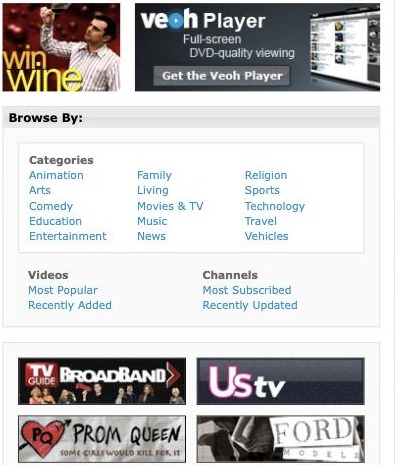
Pulled from the Internet Archive — Veoh.com as it looked while Bradley was there, before the brand's long tail took it through two more owners and a final shutdown in 2024, nearly two decades later.
Growth hacking, community, and the SDLC, all at once
Bradley led community and programmed the homepage's featured content while picking up the fundamentals of the software development lifecycle directly from the product managers, designers, and engineers around him — then turned around and applied all of it to growth hacking a platform racing to scale faster than anyone had rules for. Early user-generated video operated in genuinely uncharted legal territory: Veoh went on to win landmark DMCA safe-harbor rulings, first against IO Group in 2006, then against Universal Music Group in 2009 — upheld on appeal in 2011 — precedent that helped define how UGC platforms could operate at all.
Bradley helped pioneer early in-video ad formats — homepage takeovers, preview and post-roll units — to drive revenue and advertiser ROI before there was a standard playbook for it either.